Based on the SAA-C03 exam guideReport an error
SAA-C03· AssociateWeek 3 · Day 5~33 min read
Day 5 - Week 3 Comprehensive Review: Connecting EC2, Storage, ELB, and ASG into One Architecture
This week we covered the core of AWS's compute and storage layers. EC2 instance families and purchase options (Day 11), the principles of choosing among EBS, Instance Store, EFS, and FSx (Day 12), the ALB, NLB, and GLB load-balancing tiers (Day 13), and ASG scaling policies and operating techniques (Day 14). These four aren't independent services; they're the parts that make up a single architecture pattern.
The goal of this review isn't to memorize each one separately but to build the ability to judge "which combination is optimal for the given requirements." The SAA exam asks not about single-service knowledge but about trade-off judgment.
The Links Connecting This Week's Core Concepts
How do these four areas connect into one?
When you choose an EC2 instance (family and purchase option), you then decide what storage to attach to it (EBS/Instance Store/shared file system). To distribute traffic across multiple instances, you put an ELB in front (ALB/NLB/GLB). And what automatically adjusts the number of instances according to traffic is the ASG.
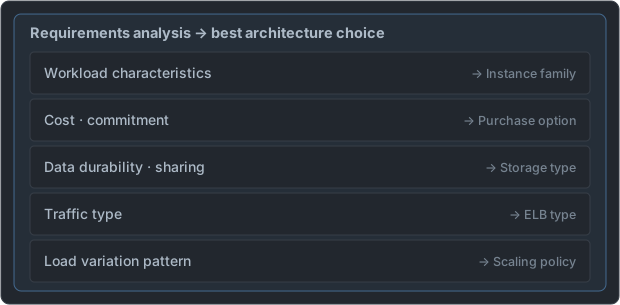
Key Comparison Tables: At a Glance
Instance Family Selection Criteria
| Bottleneck resource | Family | Representative workload | Caveat |
|---|---|---|---|
| CPU-intensive | C | Encoding, ML inference, batch | Graviton (c7g) is 25% cheaper |
| General purpose | M | App servers, caches | First choice |
| Memory | R | In-memory DB, SAP | Large RAM is the key |
| Memory (extreme) | X | SAP HANA, several TB | Very high cost |
| Local NVMe | I | NoSQL, Kafka brokers | Consider data loss |
| GPU training | P | LLM pre-training | H100/A100 |
| GPU inference | G | ML inference, rendering | A10G |
| Variable load | T | Dev, microservices | Watch T Unlimited cost |
| ARM savings | *g suffix | Open-source stacks in general | Check commercial SW compatibility |
Purchase Option Trade-offs
| Option | Commitment | Max savings | Usage conditions |
|---|---|---|---|
| On-Demand | None | 0% | Short-term, unpredictable |
| Compute SP | 1/3 years | ~66% | Family, Region, and OS can change |
| EC2 Instance SP | 1/3 years | ~72% | Family fixed, size free |
| Standard RI | 1/3 years | ~72% | Type fixed |
| Spot | Immediate | ~90% | Stateless, interruption tolerated |
| Dedicated Host | 1/3 years | - | BYOL licensing |
| Capacity Reservation | None | 0% | Reserves capacity only |
Storage Decision Tree
Just one EC2?
    └─ Need persistence?
        ├─ NO: Instance Store (NVMe, top performance)
        └─ YES: EBS
               ├─ Default: gp3 (IOPS/Throughput independent, 20% cheaper than gp2)
               ├─ High-performance OLTP: io2 (up to 64K IOPS)
               └─ Mission critical: io2 Block Express (up to 256K IOPS)

Shared by multiple EC2s?
    ├─ Linux NFS: EFS (auto-scaling, Multi-AZ)
    ├─ Windows SMB + AD: FSx for Windows
    ├─ HPC/ML parallel + S3 integration: FSx for Lustre
    └─ NetApp migration / multi-protocol: FSx for ONTAP

Object storage / HTTP API: S3
ELB 3 Types Selection Criteria
| Keyword | Answer | Reason |
|---|---|---|
| HTTP path/host/header routing | ALB | L7 content-based |
| WAF integration | ALB | WAF attaches to ALB |
| gRPC, HTTP/2 | ALB | NLB is TCP only |
| WebSocket sessions | ALB | Supports sticky |
| UDP, game servers | NLB | L4 UDP support |
| Static IP, EIP, partner whitelist | NLB | EIP per AZ |
| Ultra-low latency (μs) | NLB | L4 processing |
| Custom TCP protocol | NLB | Not HTTP |
| NGFW/IPS/DPI chaining | GLB | GENEVE L3 |
| Auto Scaling of security appliances | GLB | Appliance management |
ASG Scaling Policy Comparison
| Policy | How it works | Usage scenario |
|---|---|---|
| Target Tracking | Automatically tracks a target value (PI control) | Recommended, most situations |
| Predictive | Pre-scales using ML | Periodic patterns |
| Scheduled | Time-based pre-configuration | Predictable patterns |
| Step | Step-wise scaling size | When fine-grained control is needed |
| Simple | Simple +/- N | Legacy, avoid |
7 Traps
Trap 1. Using Instance Store for a DB The exam uses "the fastest storage" as bait to present answers that use Instance Store for a database. Instance Store data disappears when the instance stops or terminates, so it must never be used for a DB. However, it can be used as the node disk of a distributed DB such as Cassandra or MongoDB that guarantees durability through replication.
Trap 2. Using EFS for a Windows AD file share EFS is NFSv4.1-based and Linux-only. If you need Windows Active Directory integration, the SMB protocol, or NTFS ACLs, it's FSx for Windows File Server.
Trap 3. The illusion that a gp2 volume already has the max IOPS gp2's IOPS are proportional to size (1GB = 3 IOPS). A 100GB gp2 has a max of 300 IOPS. If you need more IOPS, convert to gp3 and provision IOPS independently. Converting to gp3 is possible immediately with no downtime.
Trap 4. Expecting a static IP from an ALB An ALB has only a DNS name and its IPs change. Registering an ALB IP in a partner's firewall whitelist is impossible. NLB + EIP is the answer. Global Accelerator also provides 2 static Anycast IPs, but unless the question mentions Global Accelerator, NLB + EIP is the simpler answer.
Trap 5. Detecting app failures with only the ASG's EC2 health check The EC2 health check looks only at physical/OS status. Even if the app crashes, EC2 stays in Running state, so it isn't replaced. When operating behind an ALB, you must enable the ELB Health Check type on the ASG.
Trap 6. Using Spot instances for Stateful workloads Even if "maximum savings" is in the requirements, Spot is the wrong answer for Stateful workloads (DB master, session servers, license servers). This is because they can disappear at any time after a 2-minute notice. Spot is the correct answer only for Stateless workloads (batch, big data, ML training checkpoints).
Trap 7. The illusion that NLB Cross-Zone is ON by default For ALB, Cross-Zone is ON by default (no additional cost), but for NLB and GLB it's OFF by default. If the number of targets per AZ is uneven on an NLB, traffic distribution becomes skewed. Enabling Cross-Zone incurs additional data transfer cost.
Interaction Patterns Between Services
In real architectures these services work in combination. You need to understand the representative patterns to solve scenario questions.
Pattern A: Standard 3-tier web service
Internet → ALB (Multi-AZ, HTTPS, WAF)
              ↓ Host/Path routing
         ASG (EC2, Mixed Instances, Spot 60% + OD 40%)
              ↓
         EBS gp3 (application data)
         EFS (shared config, uploaded files)
              ↓
         RDS Multi-AZ (reads via Read Replica)
Pattern B: ML training platform
S3 (training data) ←→ FSx for Lustre (S3 integration)
                          ↓ (POSIX API, hundreds of GB/s)
                   EC2 Spot (p4d.24xlarge, GPU)
                   [Lifecycle Hook: save checkpoint]
                          ↓
                   S3 (model checkpoints)
Pattern C: B2B API service (static IP required)
Partner → NLB (EIP whitelist)
              ↓ (TCP 443)
         EC2 ASG (Target Tracking)
              ↓
         RDS + ElastiCache
Pattern D: Enterprise security chain
Internet → Transit Gateway → GLB → Palo Alto NGFW (ASG)
                                       ↓ (passes inspection)
                                ALB → EC2 ASG → RDS
Pattern E: HPC cluster
EC2 c7g.metal (Cluster Placement Group)
    ├─ EFA (OS-bypass networking, 100Gbps)
    ├─ FSx for Lustre (POSIX, ultra-fast parallel I/O)
    └─ Instance Store (temporary scratch)
Cost Optimization Pattern Summary
When "cost optimization" appears in a scenario, analyze it with this framework.
1. Classify the workload
   - Stateless + interruption tolerated → Spot (up to 90% savings)
   - Predictable baseline load → Compute SP or RI
   - Short-term/unpredictable → On-Demand

2. Instance right-sizing
   - Check whether Graviton (ARM) is possible (25% savings)
   - Pick the family based on actual CPU/memory utilization

3. Storage optimization
   - Convert gp2 → gp3 (20% savings)
   - EFS IA Lifecycle Policy (automatic tiering of long-unaccessed files)
   - S3 Intelligent-Tiering or Glacier

4. Usage pattern optimization
   - Scheduled shutdown of nighttime dev/test ASGs
   - Analyze actual CloudWatch usage data before applying Reserved Instances
Reliability Design Patterns
When "keep the service running even if one AZ fails" appears in a scenario:
Required checklist:
□ ALB: Multi-AZ subnets (at least 2 AZs)
□ ASG: Min=2 or more, register multiple AZ subnets
□ RDS: Multi-AZ deployment (synchronous replication)
□ ElastiCache: Redis Cluster Mode Enabled (Multi-AZ)
□ EFS: Multi-AZ mount targets
□ S3: Multi-AZ durability by default (no separate setup needed)
When "keep the service running even if an entire Region fails" appears:
Additional requirements:
□ Route 53 Health Check + Failover records
□ RDS Cross-Region Read Replica (manual promote)
  or Aurora Global Database (RPO < 1 second)
□ S3 Cross-Region Replication
□ CloudFront (edge cache buffers origin failures)
□ ASG + EC2 standby stack in a second Region
📝 Practice Questions
Click a choice to reveal the answer and explanation.
Question 1
A global e-commerce platform runs in the AWS Seoul Region. Design an architecture that satisfies all of the following requirements. - Traffic is 5 times normal from 8:00 to 18:00 Monday through Friday - No service interruption on a single AZ failure - Guarantee baseline capacity while minimizing cost - Need to defend against SQL Injection attacks
Question 2
A company is migrating from on-premises NetApp ONTAP storage to AWS. Both Linux and Windows servers must access the same file system, and it plans to migrate gradually while synchronizing with SnapMirror from on-premises. Also, after the migration is complete, both NFS and SMB must be supported. Which service is suitable?
Question 3
A financial trading company is moving its new order system to AWS. Requirements: (1) minimize network latency (μs level), (2) a static IP must be registered in the whitelist on the partner system's firewall, (3) use the FIX protocol (a TCP-based custom protocol), (4) MPI communication between order-processing servers. What is the most suitable architecture?
Question 4
A startup is launching a new SaaS product. Traffic is very low at first, but if it succeeds it could surge by dozens of times. It must handle a surge that could occur at any time within 1 year without service interruption, while minimizing cost. It's planned to operate for 3 years or more in the long term.
Question 5
A company runs a PostgreSQL database on EC2 using an EBS gp2 volume (200GB). The DBA's analysis shows average IOPS usage of 800 and a peak of 2,000, exceeding gp2's maximum IOPS of 600 (200GB × 3), causing performance degradation. What is the most cost-effective solution?
Question 6
For a web server run by an Auto Scaling Group, every time a new instance starts the following tasks are needed: fetch DB connection info from Parameter Store, create the config file and start the app, and warm up the Redis cache. This whole process takes 4 minutes. If ALB traffic arrives before the 4 minutes are complete, errors occur. What is the most appropriate setting?
Question 7
A company is moving on-premises physical servers to AWS. Among the migration targets are a SQL Server Enterprise license (billed per socket) and Oracle DB (billed per CPU core). To use the licenses on AWS as BYOL?
Question 8
A video streaming service runs a pipeline that processes user-uploaded videos. The video encoding jobs are CPU-intensive and take 30-120 minutes. If an encoding job is interrupted, it can restart from the last checkpoint (saved to S3 every 10 minutes). To operate reliably while cutting cost as much as possible?
Question 9
Which of the following is the combination of settings that maximizes availability on a Spot instance interruption in an ASG?
Question 10
A company runs a 10TB-scale data analysis every Sunday at 2 a.m. The analysis needs a large amount of RAM (256GB), and the results are stored in S3. The analysis job can't be interrupted, and the instance can be terminated after completion. What is the most cost-effective method?
Question 11
In a multi-account environment, two teams want to place resources in the same ap-northeast-2a AZ to use VPC peering without Cross-AZ cost. However, there's a concern that the actual physical AZs may differ. How should they verify?
Question 12
Select all of the following that are representative patterns of wrong choices on the SAA exam.